 |
Henderson Articles- Sydney Sunday Herald 1950 Feature Article October 5, 1955 Henderson Whip Pictures- 48 x 24 plait Stockwhip Colonel Tim McCoy's Stockwhip 48 x 24 plait 2 tone Stockwhip 24 plait 2 tone thong Henderson Crop 36 plait 12 foot Bullwhip 36 plait Half Plait Stockwhip 36 plait Full Plait Stockwhip 24 x 16 plait Stockwhip Henderson Mentions and Clippings- T Henderson & Sons Price List 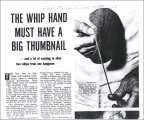 Click the picture to see a scan of the article. 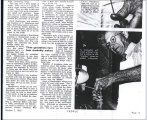 Click the picture to see a scan of the article. 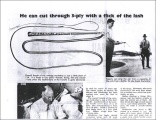 Click the picture to see a scan of the article. 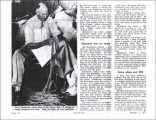 Click the picture to see a scan of the article. |


| Home | Photo Gallery | Film Work | Whip Construction | Q & A | Links | Contact Us |
|
THE WHIP HAND MUST HAVE A - and a lot of cunning to slice two whips
from one kangaroo
October, 5 1955 The few men in Australia still making stockwhips have a common physical characteristic. Their right thumb nails are carefully kept unusually long. The long nail is their badge of trade. They use it as a gauge of width when cutting strands from a hide. They are able in this way to cut long strips with extraordinary speed and accuracy. Some men can cut a 500ft strand without pausing, working around and around the perimeter of the hide. Cecil Henderson, sole remaining member of T. Henderson and Sons, stockwhip makers and plaiters, of George Street, Sydney, is one of these highly skilled craftsmen. He has spent 50 of his 64 years in the trade. Stockwhip-making, a flourishing business in Henderson’s youth, is now a dying art. The demand for whips has fallen and few new people are entering the trade. Youths today are reluctant to serve the five years’ apprenticeship because they can get bigger money for unskilled work. Henderson'’ at one time had a staff of nine. Today Cecil Henderson works alone. There have been three generations of stockwhip makers in Henderson’s family. His grandfather started the business in Victoria 70 years ago. His father took over and was head of the firm until his death in 1921. Cecil Henderson’s two brothers worked with him for many years, but both have retired. When Cecil lays down his tools the business will close. He has no sons to succeed him. Henderson’s whips go all over Australia. At one time, he says, a Henderson whip was the only type that could be sold in some parts of the north. A few go to America where they earn dollars for Australia. Famous Australian sportsman Reg. L. (Snowy) Baker, who died in 1953, introduced the Henderson whip to America. At his suggestion, cowboy comedian Will Rogers sent to Sydney for one. Other film stars, including Douglas Fairbanks Sen., also used Henderson whips. Fairbanks used one in an escape scene for the film Son of Zorro. He swung the whip over a wall then hauled himself up it to the top. Henderson recently repaired three whips which belonged to Snowy Baker. Baker left them to Los Angeles sports store proprietor C. Pesterre. Pesterre sent them to Henderson for repair because he considered him the only man capable of doing the job properly. American stockmen, connoisseurs of plait work, have bought Henderson whips in preference to those of their own craftsmen. They buy the Australian whips because they are better made and because the leather Henderson uses is kangaroo hide. Kangaroo hide, a thin leather, is the toughest for its weight in the world. Henderson makes a few whips from bullock hide for rough work, but the proportion of these to kangaroo whips is only about one in every 200. The type of kangaroo hide most suitable for whip making is the winter skin of a medium-sized doe of the red or blue flier variety. Henderson can cut two whips from a large hide. Bundles of kangaroo skins are scattered about his sombre, cluttered workroom. In dusty glass cabinets lie some of the best examples of Henderson’s skill, whips of delicate balance and intricate plait, their handles bearing the names and addresses of owners woven into the leather. Some of Henderson’s whips have lasted 30 years and more. But a whip’s life depends almost entirely on how it is cared for. Jackeroos have worn them out in as little as three months by cracking them on hard and stony ground. Henderson has in his workroom one 30-year-old whip which he uses occasionaly to demonstrate the fall (movement through the air) and crack of the well-made whip. Although no stockman, he can make it crack like a pistol shot. The whip was sent to him by mail for repair 15 years ago. The owner forgot to enclose his address and Henderson has been waiting ever since for him to claim it. The overall length of the average stockwhip is just a little short of 12ft. Leatherwork in the average handle varies from 16 to 24 plait. The average thong is from 12 to 16 plait. Inside a normal 12 plait thong there is a four plait core. Bigger whips have two of these cores. Henderson has made special showpiece whips with 56 plait thongs and his father once made a monster whip with a thong 55ft long. Showman was too smart Old Henderson offered a free whip to anyone who could crack the giant. He was fairly confident no one would collect. For one thing, the whip handle was too thick to be held in one hand. But a showman named Saltbush Bill did the trick. He tucked the base of the handle under his arm, grasped the narrower top with his hand and swung the whip with a cramped motion. It cracked, and he won the prize. Henderson makes both stockwhips and bullwhips. The bullwhip, which is used mainly in America, has a handle in line with the thong. Henderson considers the Australian whip the better of the two. It is much easier to carry than the bullwhip because its separate handle can be dangled over the arm or shoulder. There are four parts to a stockwhip—the handle, the thong, the fall and the cracker. Handles, which are usually about 19 inches long, have a core of cane, cane-covered steel or whalebone. The steel cores are springiest, but Henderson prefers the common lawyer-cane core, which has little resilience. He says the stiffer handle produces a whicher return of the thong. Showmen, who work particularly fast with their whips, use a wooden core, which has practically no give. Before plaiting a thong, Henderson tugs the leather strands to take the stretch out of them. He then bevels the edge of each strand with a razor-sharp penknife. This gives the whip a smooth-rolling action. Henderson can bevel a 16ft strand in a second or two. He takes off a layer about 1/32nd of an inch wide and paper-thin in a single strip, which hardly varies from end to end. To the end of the thong is attached the fall, a strip of leather about a quarter of an inch wide and generally about 27in long. Joined to this is the cracker, a pieve of twisted cotton, silk, flax or horsehair, usually about 6in long. Henderson favors a cotton cracker because it is cheap and apparently just as effective as the others. He has experimented with a nylon cracker but has decided it has no particular advantages. Like the other materials nylon is liable to fly (disintegrate slightly when cracked) in wet weather. Some whips cost 50 A whip will crack without a cracker, but the little tag at the end gives the sharpness to the report. A cracking stockwhip exerts great force. The uncoiling tip will cut a bottle in half. Henderson has cut through three-ply with a flick of the lash. Henderson makes some whips in half a day, but spends up to a fortnight on the elaborate types. He charges as much as 50 for these special whips. The tempo of his work has slowed down in recent years. He has a weak heart and is now content to work at a leisurely pace. When he leaves the business another old craft will be nearer extinction. # |