 |
Henderson Articles- Sydney Sunday Herald 1950 Feature Article October 5, 1955 Henderson Whip Pictures- 48 x 24 plait Stockwhip Colonel Tim McCoy's Stockwhip 48 x 24 plait 2 tone Stockwhip 24 plait 2 tone thong Henderson Crop 36 plait 12 foot Bullwhip 36 plait Half Plait Stockwhip 36 plait Full Plait Stockwhip 24 x 16 plait Stockwhip Henderson Mentions and Clippings- T Henderson & Sons Price List 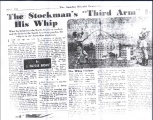
Click the picture to see a scan of the article. 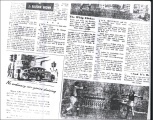 Click the picture to see a scan of the article. |

| Home | Photo Gallery | Film Work | Whip Construction | Q & A | Links | Contact Us |
|
The Stockman's "Third Arm" Is His
Whip Page Two of The Sunday Herald Features
By J. Balfour Brown 1950 What the lariat is to the North American cowboy, and the bolas to the South American gaucho, the whip is to the Australian stockman. I SAW the sign and went up. It read, “T. Henderson and Sons, Station and Stockwhip Makers.” He was an old man, Cecil Henderson, and he said he had been making whips now for 45 years. He was one of the sons. His father had started the firm in 1885. I wanted to talk to him because I had heard about him first from a stockman on the upper Hunter. And a cattleman hundreds of miles away on the Bowen in North Queensland had shown me a whip made by him. The Australian stockman rides a different kind of horse, wears different clothes, uses different gear to men who handle stock in other parts of the world. One of the things that sets him apart is his stockwhip. Like him it is unique. With his whip the stockman, if he is good enough, can leave his initials in a beast at full gallop. He can knock a man down; he can trip a flying calf; he can appear to be flogging a beast yet in reality be not even touching it. Even if he doesn’t reach the standard necessary to do these things he uses his whip for a hundred and one things. He leads horses with it; kills snakes; knots it for every hundred when he is out counting a big mob of cattle or sheep. And when he is mustering or droving the stockwhip becomes a third arm. The tricks the station hands used to play with their whips in the old days have been developed and improved on. There must be very few people, city dwellers even, who haven’t seen some “flash” stockman at a show cracking cigarettes out of a girl’s lips, cuting chalk stuck in her ears, doing the “five crack” over and over, cracking whips in each hand. The cowboy uses the lariat—a rope with a noose at the end. The gaucho throws the bolas—a short piece of rope with weights at each end. The stockman is just as expert—and faster—with his whip. * * * CECIL Henderson is a man who knows whips. In his workshop in George Street, he told me: “The two-piece Australian whip is on its own, I’m sure about that. “It is easy to carry and if it is balanced properly, a good man can do anything with it. “When we make a whip we make it to fit the man who is going to use it. “The Australian whip, you know, is different to anything else in the world. In South Africa they use the zhambok, very cruel but awkward because it is all one piece like the old slave-whip. In America when they use a whip it is the bull-whip. It is short-handled and more a hitting whip than a cracking whip. We’ve made them all, though, in our time” He said it took him two days to make a good whip; sometimes longer. He could make one quicker than that if he had to but it wouldn’t be a good job. “When you make a stockwhip,” he said, “you really make two. You plait one and then plait another over the top of the first. “I’m on my pat now,” he added. “But my two brothers Rupe and Dudley come in when I need help. “Once we had ourselves and nine men working for us. There are still plenty of orders though—I just can’t meet them all. Now I only do stockwhips. In the old days we made a lot of buggy whips and driving whips.” * * * CECIL HENDERSON and his brothers have made some interesting whips. There was the riding crop they plaited for the Prince of Wales when he was out here just after the first war. There were whips they sent to India, South Africa, and Tunis. And others they sent to America, England, New Zealand, and Canada. They made a 55-foot whip for Saltbush Bill Mills--one of the first bushmen to win international fame for his prowess with the stockwhip. He makes his stockwhips from six up to twenty feet long. Seven or eight feet is the average length. For the handles he uses plaited leather over a steel shaft or cane. “The handle is really just as important as the rest of the whip,” he siad. “A handle too long or too short can destroy the balance properly.” The handle, and the way the whip is fixed by an interlocking keeper to the handle, is where the Australian whip differs most from others. Cecil Henderson cuts and *** the leather for his whips himself. “This,” he said holding up a piece of kangaroo hide, “is the main reason Australian whips are so good. My old father used to say that kangaroo hide, for it’s weight was seventeen per cent stronger than any other. I makeup a few chrome hide (mineral cured bullock hide) whips and some bushmen like a green hide whip even better. “Kangaroo hide though works into a beautiful finish and you can plait all sorts of designs.” “But,” he added, “there isn’t as much of it around as there used to be. They seem to be supplying it to the fancy leather ******* to make things like cigarette c*******, wallets and bags, and watchbands. I didn’t have to say it. We all knew it perfectly well though. There aren’t as many whip makers like Cecil Henderson around as there used to be either. ***** = Unreadable |